


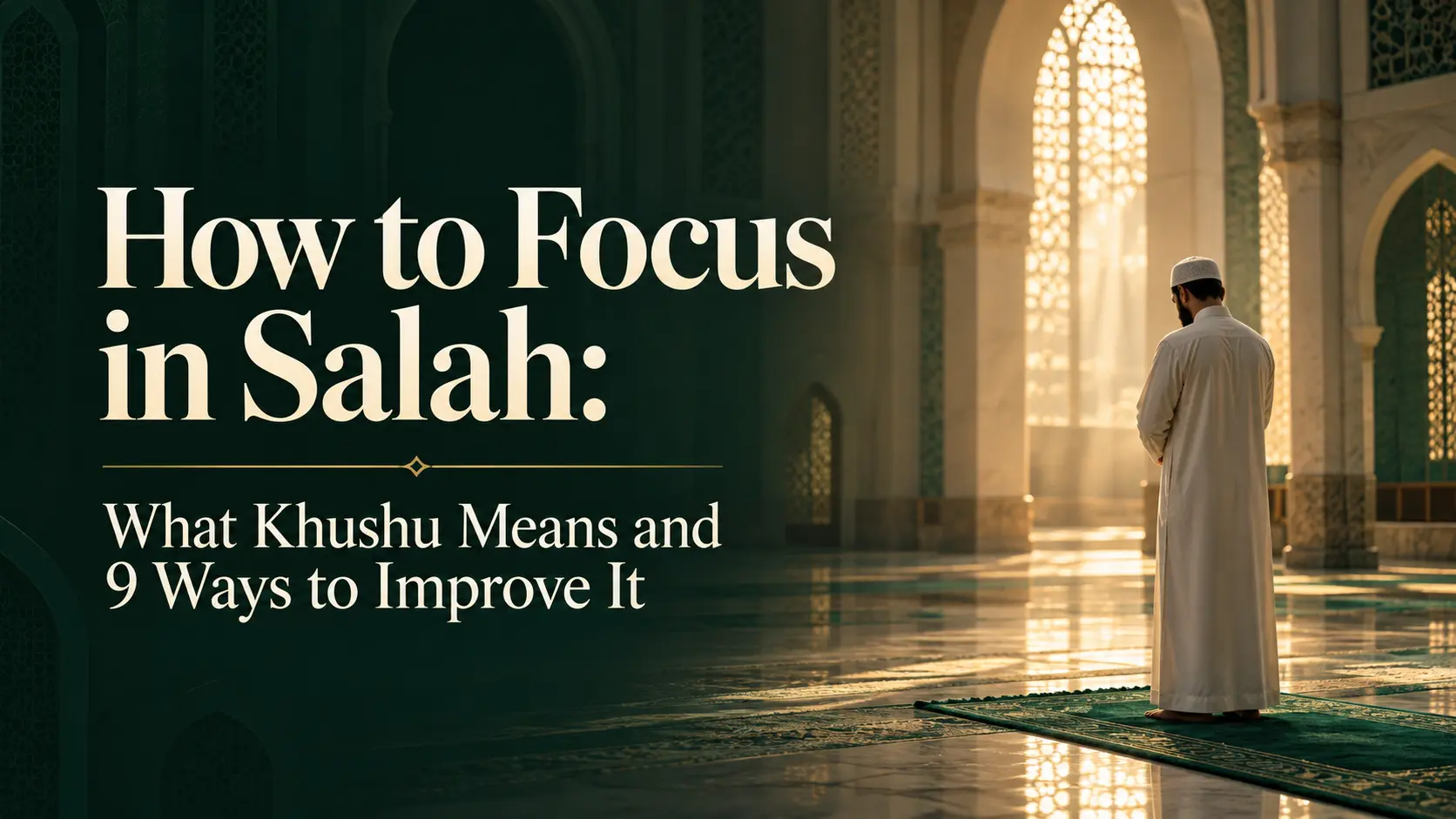
How can you focus better in Salah?
To focus better in Salah, begin before the opening takbir: protect enough time for prayer, remove predictable distractions, and remember why you are standing before Allah. During the prayer, understand the words you repeat, give attention to the current recitation and posture, and return calmly whenever the mind wanders. Afterward, improve one recurring source of distraction instead of demanding perfect concentration from the next prayer.
Khushu is commonly discussed through humility, submissiveness, stillness, attentiveness, and the heart's awareness before Allah. This guide gives a practical introduction, not one exhaustive scholarly definition. It also does not say that every unwanted thought invalidates a prayer or proves weak faith. Prayer validity, deficiencies, doubts, and repeated mistakes can involve legal details that belong with qualified scholars.
- Before Salah: protect the time, prepare, and remove what predictably pulls attention away.
- At the beginning: pause long enough to recognize that you are entering worship, not merely completing a task.
- During Salah: follow the words and current posture rather than monitoring whether you feel perfectly focused.
- When attention wanders: notice it, return, and continue without turning the distraction into a second distraction.
- After Salah: identify one practical adjustment for the next prayer and avoid judging acceptance from a feeling alone.
What does Khushu mean in Salah?
The opening of Surah Al-Mu'minun names humility in prayer among the qualities of successful believers. The verse uses a form of the Arabic root associated with Khushu. English translations may emphasize humility, submission, reverence, or attentiveness; each translation points toward part of a rich concept rather than exhausting it in one word.
“Successful indeed are the believers: those who humble themselves in prayer.”
Quran 23:1–2Quran 23:1–2 — Humility in prayer
Khushu is therefore more than forcing the mind to become blank. Prayer contains recitation, remembrance, praise, requests, bowing, and prostration. Attentiveness has content: the worshipper is responding to Allah with the heart and body. A quiet room can support that response, but the room itself does not create humility. Likewise, a wandering thought does not tell the whole story of a person's worship.
“So worship Me alone, and establish prayer for My remembrance.”
Quran 20:14Quran 20:14 — Establishing prayer for Allah's remembrance
This verse connects prayer with Allah's remembrance. It helps correct a common mistake: treating concentration itself as the object of prayer. The goal is not to admire one's ability to focus. Attention serves remembrance, worship, humility, and sincere response to Allah.
Khushu does not mean never having another thought
Many people finish a prayer and remember only the moments when their mind wandered. They then conclude that the entire prayer was empty. That conclusion can produce discouragement without helping the next prayer. Attention naturally needs to be returned; what matters practically is how the worshipper prepares, responds, and continues striving.
Do not spend the prayer repeatedly asking, “Am I focused now?” That question pulls attention away from the verse, remembrance, or posture in front of you. When you notice a distraction, return to the current act. The return itself is part of the effort. Improvement may appear as noticing sooner, understanding more of the recitation, rushing less, or removing a repeated distraction before the next prayer.
This practical reassurance is not a ruling that every error has no legal effect. If you are unsure about the number of units, omitted an element, or have recurring doubts about validity, ask a qualified scholar for guidance specific to that issue rather than relying on a general article about attention.
1. Protect enough time before Salah begins
Focus is harder when prayer is squeezed between two tasks with no transition. If you begin while mentally finishing an email, watching the clock, or planning an immediate departure, those unfinished demands often follow you into the prayer. Planning does not guarantee Khushu, but it can remove avoidable pressure.
- Check the prayer time before the day becomes crowded rather than discovering it when another commitment is already beginning.
- Allow a realistic transition for stopping the current task and preparing without unnecessary haste.
- Where possible, finish a short unit of work instead of leaving yourself in the middle of one sentence, message, or calculation.
- If a thought is genuinely important, record one brief reminder before preparing so you do not keep rehearsing it during prayer.
A consistent prayer schedule can create the space in which attention is easier to protect. The companion guide develops the scheduling system in detail: know the time, decide the place, prepare the transition, and return calmly after a disrupted day.
For the complete planning framework, read how to stay consistent with Salah across all five prayers.
Use Ebaadah to check today's local prayer times.
2. Prepare your body and prayer place deliberately
Preparation can help the mind recognize that one activity is ending and worship is beginning. Complete the required preparation carefully, choose a suitable space, and address ordinary needs that would predictably interrupt you where doing so is appropriate. The purpose is not to build an elaborate pre-prayer ritual but to enter Salah ready to remain there.
- Use wudu as a real transition into worship rather than racing through it while consuming unrelated content.
- Choose a stable prayer place when possible so finding a space is not a fresh decision every time.
- Wear appropriate clothing that does not require repeated adjustment or compete for your attention.
- Settle urgent, reasonable needs before beginning when that is within your control.
- Keep the environment comfortable enough for prayer without making ideal comfort a condition for worship.
Personal circumstances differ. Illness, disability, caring responsibilities, work, school, travel, and safety may change what preparation is possible and may raise religious questions. Seek appropriate support and qualified guidance instead of treating one routine as universal.
3. Remove distractions you can predict
Not every distraction can be removed, but repeated ones can often be addressed before prayer. Sahih al-Bukhari records that a marked garment drew the Prophet's attention during prayer, after which he asked for a plain garment instead. The narration gives a concrete example of changing the environment when something has distracted from Salah.
“It has diverted my attention from the prayer.”
Sahih al-Bukhari 373Sahih al-Bukhari 373 — Removing a visual distraction
- Silence or place the phone out of sight instead of trusting yourself not to react to a visible screen.
- Move visually demanding objects when they repeatedly catch your attention.
- Tell household members when you need a brief uninterrupted period where that is realistic and safe.
- Choose a place away from active conversations, television, or passing traffic when another suitable place is available.
- If one distraction repeats, change that specific condition before adding more general concentration advice.
A plain environment is a support, not the definition of Khushu. Some people pray in unavoidable noise, public places, shared homes, or demanding conditions. The aim is to remove what can reasonably be removed without delaying prayer while waiting for a perfect setting.
4. Learn the meaning of what you say repeatedly
Attention has somewhere to rest when the worshipper understands the praise, requests, and remembrances being spoken. Begin with Al-Fatihah because it is repeated through the prayers and carries a direct relationship between praise, worship, seeking help, and asking for guidance.
“I have divided the prayer into two halves between Me and My servant, and My servant will receive what he asks.”
Sahih Muslim 395aSahih Muslim 395a — Al-Fatihah in the prayer
The narration then describes Allah's response to the verses of Al-Fatihah. Learning this hadith can help the surah feel less like a familiar sequence passed through quickly and more like praise and supplication addressed to Allah. Study the meaning through a reliable translation and qualified explanation; word-for-word familiarity is useful, but it is not a replacement for tafsir.
- Learn one line of Al-Fatihah at a time with a reliable meaning.
- Connect the Arabic you recite to the praise, commitment, or request it contains.
- Review the meanings outside Salah so the prayer is not the first time you try to remember them.
- Ask a qualified teacher about wording or explanation you do not understand instead of inventing a private interpretation.
5. Begin with a conscious purpose
A person can move from preparation into prayer so quickly that the body begins before attention catches up. Before the opening takbir, stop unrelated speech and movement, face the prayer, and recognize that the next moments are worship of Allah. This does not require an invented verbal formula or a long exercise.
Use the opening transition to release the task you have just left. You may need to tell yourself, in ordinary language outside the prayer, that the message, plan, purchase, or worry can wait. Then direct attention to Allah's remembrance rather than to the goal of producing a particular emotion.
Some prayers will begin with a strong sense of presence and others will not. Do not delay worship while waiting to feel spiritually ready. Preparation serves obedience; it does not make an emotional state a precondition for beginning.
6. Give attention to the current word and posture
Trying to hold the entire prayer in the mind at once can create another layer of pressure. Narrow attention to what is happening now: the verse being recited, the remembrance being said, or the posture being performed. When the prayer moves, let attention move with it.
- During recitation, listen to the words you are actually saying rather than thinking ahead to the next surah or task.
- During praise, remember that you are praising Allah rather than merely completing familiar syllables.
- During a request for guidance or help, recognize the need expressed in the words.
- During bowing and prostration, avoid racing mentally toward the end of the prayer.
This is attention guidance, not a new rule about how long each posture must last or what must be recited. Learn the correct performance of Salah from qualified teachers. The practical point is to stop living mentally in the next moment while the body is worshipping in the present one.
7. Return gently when your mind wanders
A wandering thought often becomes longer because the worshipper reacts to it with frustration: “Why am I thinking about this again?” Now the mind is occupied by both the original thought and self-criticism. Instead, notice that attention has moved and return to the current verse, remembrance, or posture.
- Notice the distraction without following its story.
- Do not conduct a full argument with yourself inside the prayer.
- Return to the words you are saying or hearing now.
- Continue the prayer without trying to manufacture a dramatic feeling of recovery.
- Afterward, address the source only if it is recurring and changeable.
If you experience persistent intrusive thoughts, anxiety, trauma responses, ADHD-related attention difficulties, or another health concern, do not treat that experience as a simple verdict on faith. Qualified clinical support and qualified religious guidance can each address different parts of the difficulty; this article is not medical treatment.
8. Use the sourced response to recurring whispering
Sahih Muslim records that 'Uthman ibn Abi al-'As complained that Satan interfered between him and his prayer and confused his recitation. The Prophet identified the whispering and instructed him to seek refuge with Allah and spit lightly to his left three times. 'Uthman reported that Allah removed it from him.
“Seek refuge with Allah from it and spit three times to your left.”
Sahih Muslim 2203aSahih Muslim 2203a — Seeking refuge from distraction in prayer
Keep the narration's wording and context clear. The instruction concerns whispering during prayer; it is not permission to spit saliva onto people, furnishings, or a mosque. The Arabic verb is commonly explained as a light, dry spitting gesture. Because practical circumstances and legal details matter, learn its proper application from a qualified teacher rather than improvising from a short quotation.
This sourced response can accompany the ordinary steps already discussed: understanding the recitation, removing distractions, and refusing to follow each unwanted thought. Do not build an elaborate theory around every distraction or label every attention problem in the same way.
9. Review one prayer and make one adjustment
Improvement becomes manageable when the review is specific. Choose one prayer from the day and ask what helped, where attention repeatedly moved, and what can be changed before tomorrow. Do not assign a percentage to Khushu or turn the prayer into a performance score.
| Question | Useful response | Avoid |
|---|---|---|
| What helped? | A clear transition, understood words, or a quieter place | Claiming the prayer was accepted because it felt good |
| What distracted me? | One recurring thought, object, sound, or unfinished task | Listing every passing thought and increasing anxiety |
| What will I change? | One practical preparation before the next prayer | Designing a demanding system that becomes another distraction |
| What needs guidance? | A clear question for a qualified teacher or scholar | Guessing about validity, mistakes, or legal rulings |
Examples of one adjustment include silencing a device, reviewing one line of Al-Fatihah, beginning preparation five minutes earlier, or moving a distracting object. Keep the adjustment long enough to learn whether it helps. Khushu is not improved by constantly replacing one complicated method with another.
A seven-day plan for improving focus in Salah
This seven-day sequence is a practical review period, not a promise that Khushu will be achieved in a week. Continue guarding all five prayers while focusing each day on one support around attention.
- Day 1 — Observe which prayer is most often rushed or distracted and what happens immediately before it.
- Day 2 — Protect a clearer transition into that prayer without delaying it for perfect conditions.
- Day 3 — Remove one recurring visual, digital, or environmental distraction.
- Day 4 — Learn the reliable meaning of one line of Al-Fatihah and review it outside prayer.
- Day 5 — Practice returning to the current words without arguing with each wandering thought.
- Day 6 — Give attention to one repeated praise or request and understand what you are saying.
- Day 7 — Review one prayer privately and keep the single adjustment that was most useful.
Do not postpone this week's prayers until the plan is complete. The plan exists to support worship already due, not to create a preparation program that becomes more important than Salah itself.
Common mistakes when trying to improve Khushu
- Treating a perfectly quiet mind as the definition of Khushu and becoming discouraged by every unwanted thought.
- Monitoring concentration so intensely that the monitoring itself replaces attention to the prayer.
- Assuming that a strong emotion proves acceptance or that an emotionally difficult prayer proves rejection.
- Learning inspirational descriptions without learning the meanings of the words repeated in Salah.
- Waiting for a perfect room, schedule, or mood before beginning prayer.
- Adding unsourced formulas, fixed exercises, or guaranteed timelines and presenting them as religious teachings.
- Giving blanket rulings about validity, doubts, omitted actions, or repeated mistakes without qualified knowledge.
- Shaming people whose attention is affected by health conditions, disability, trauma, caregiving, or difficult environments.
Key takeaways
- Khushu includes humility and attentiveness in prayer, but one English word does not exhaust its meaning.
- Focus serves remembrance and worship of Allah; concentration is not an end in itself.
- Prepare before Salah by protecting time, completing the transition, and removing predictable distractions.
- Learn the meaning of Al-Fatihah and other repeated words through reliable translation and qualified explanation.
- When the mind wanders, return to the present recitation or posture without extending the distraction through self-criticism.
- Use source-backed guidance for recurring whispering and ask qualified teachers about its proper application.
- Do not infer validity, acceptance, or weak faith from feelings of concentration alone.
Frequently asked questions
What does Khushu mean in Salah?
Khushu is commonly explained through humility, submissiveness, stillness, attentiveness, and awareness before Allah in prayer. The concept has a rich scholarly treatment, so this practical guide does not present one brief English definition as exhaustive.
Does a wandering mind invalidate Salah?
This guide does not issue a blanket ruling about validity or acceptance. Passing thoughts, uncertainty about units, omitted actions, and recurring doubts are not all the same question. Ask a qualified scholar about the exact situation rather than deciding from concentration alone.
What should I do when my mind wanders during prayer?
Notice that attention moved, avoid following the thought or criticizing yourself at length, and return to the words or posture currently in the prayer. Afterward, change one recurring external cause if it is within your control.
How can I focus if I do not understand Arabic?
Begin by learning the reliable meaning of Al-Fatihah and the remembrances you repeat most often, a small amount at a time. Review meanings outside Salah and learn recitation and explanation from qualified teachers rather than relying indefinitely on transliteration or personal interpretation.
Can phones and visual objects reduce focus in Salah?
They can distract some worshippers. Sahih al-Bukhari 373 records that a marked garment drew the Prophet's attention and was replaced with a plain one. Remove predictable distractions where reasonably possible without making perfect surroundings a condition for prayer.
What does Sahih Muslim say about whispering during prayer?
Sahih Muslim 2203a records guidance to seek refuge with Allah and make a light spitting gesture to the left three times when affected by the named whispering. Learn the proper, considerate application from a qualified teacher, especially in shared spaces or a mosque.
Sources and references
- Quran 23:1–2 — Humility in prayerTranslation: The Clear Quran by Dr. Mustafa Khattab
- Quran 20:14 — Establishing prayer for Allah's remembranceTranslation: The Clear Quran by Dr. Mustafa Khattab
- Sahih Muslim 395a — Al-Fatihah in the prayerReported from Abu Huraira in Sahih Muslim, Book 4, Hadith 41
- Sahih al-Bukhari 373 — Removing a visual distractionNarrated by 'Aisha in Sahih al-Bukhari, Book 8, Hadith 25
- Sahih Muslim 2203a — Seeking refuge from distraction in prayerReported from 'Uthman ibn Abi al-'As in Sahih Muslim, Book 39, Hadith 92